Where Are the Wildebeest Right Now? Great Migration Month-by-Month Guide
If you have ever typed “where are the wildebeest right now” into a search bar, you are already halfway to planning a smarter Serengeti safari. The Great Migration is a year-round, rain-driven loop, and knowing roughly where the herds should be in your travel month changes which park you base yourself in, which camp makes sense, and what kind of drama you can realistically expect to see.
On This Page
Not Sure Which Month Is Right for You?
Tell us your travel dates and we will tell you where the herds are likely to be that week, and which camps make sense at your budget.
A Journey With No Beginning or End
Roughly 1.3 to 1.5 million wildebeest, alongside hundreds of thousands of zebra and gazelle, move in a broad clockwise loop across the Serengeti and into Kenya’s Masai Mara and back again, chasing fresh grass wherever rain has just fallen. There is no starting line and no finish: a wildebeest’s migration begins the moment it is born and continues for the rest of its life. That is why “when is the Great Migration?” is the wrong question. The better question is “where are the herds in my travel month, and what does that mean for my trip?”
Around 1.3 to 1.5 million wildebeest move through the Serengeti-Mara ecosystem each year, together with close to 200,000 zebra and several hundred thousand gazelle, all following the rains rather than a calendar.
Month-by-Month: Where the Herds Are
The pattern below is a reliable general rhythm, not a guarantee. Rainfall decides the exact week, so treat every month as “most likely” rather than “certain”.
December to March: Southern Serengeti and Ndutu
The herds gather on the short-grass plains around Ndutu, on the southern edge of the Serengeti and inside the Ngorongoro Conservation Area, for calving season. Many thousands of calves can be born in a single day at the peak, usually in February, and the concentration of vulnerable newborns draws lion, hyena and cheetah for some of the most intense predator action of the year.
April to June: Central and Western Serengeti
As the long rains ease, the herds push north through the Seronera area in long, dust-raising columns. By June the leading edge often reaches the Western Corridor, where the Grumeti River can present the first serious water crossings of the year. It is dramatic, and usually far quieter than what comes later. This is also the green season, so expect lower rates and the odd afternoon shower.
July to October: Northern Serengeti and the Mara River
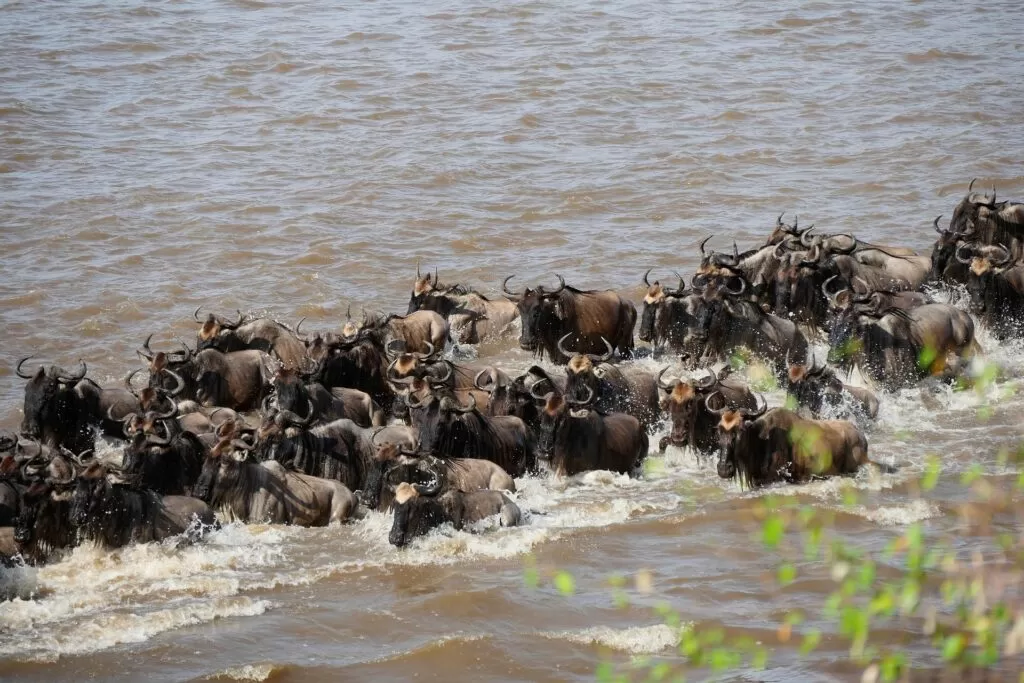
This is the season most people picture: herds massing on the riverbank, hesitating, then surging across the Mara River while crocodiles wait below. Crossings are most likely from roughly July to September, though the exact week varies. It is also when the northern Serengeti sees its highest visitor numbers and its highest camp rates, so book early.
November: The Herds Turn South
As the short rains begin, the herds start heading back toward the southern plains. Camps are quieter, prices often soften, and the wildlife has not gone anywhere.
Because the migration follows rainfall rather than a calendar, the same month can look different from one year to the next. That is why a route built around this year’s rain, not last year’s photographs, matters.
How to Time Your Trip
| Season | What You’ll See | Crowds | Price Level |
|---|---|---|---|
| Dec – Mar | Calving season, newborn calves, intense predator action | Moderate | Moderate to high |
| Apr – Jun | Green season, Grumeti crossings, dramatic skies | Lower | Usually lowest of the year |
| Jul – Oct | Mara River crossings, peak drama | High | Usually highest of the year |
| Nov | Herds moving south, quiet camps | Lower | Often discounted |
For a full season-by-season breakdown covering every park, read our month-by-month guide to the best time to visit Tanzania.
Safari Itineraries That Follow the Herds
If your priority is the northern river crossings, our 7-day northern Serengeti Great Migration safari is built around exactly that. If you have less time, the 4-day Tanzania safari adventure or 4 days in northern Tanzania pair the Serengeti with Ngorongoro Crater. Wider routes combining Tanzania and Kenya appear in our 10-day Tanzania and Kenya safari. Park rules, fees and conditions are published by Tanzania National Parks (TANAPA) and the Ngorongoro Conservation Area Authority, and are worth checking before you travel.
Is Now the Right Time for You?
- You want the dramatic river crossings and don’t mind peak-season rates
- You would rather witness thousands of newborn calves than one river crossing
- You want the same wildlife for meaningfully less, and don’t mind the odd afternoon shower
- You’re flexible on dates and want an itinerary built around this year’s rainfall, not a fixed month
Let's Build Your Migration Safari
Send us your travel window and we will map an itinerary around where the herds will realistically be when you land.
Frequently Asked Questions
What is the best month to see a Mara River crossing?
Crossings are most likely from roughly July to September, though the exact week shifts with rainfall and varies from year to year. No operator can guarantee a crossing on a given day.
Where are the wildebeest right now?
Use the month-by-month pattern above as a guide: south and Ndutu in December to March, central and western Serengeti in April to June, north in July to October, and heading south again in November. For live conditions on your travel dates, message us and we will check with guides in the field.
Can I see the migration without paying peak-season prices?
Yes. April to early June offers herds in the central and western Serengeti during the green season, usually at lower camp rates than the July to October peak.
Is there a migration in January and February?
Yes. The herds are usually on the southern plains around Ndutu, and February is typically the peak of calving season.
Do you track the herds, or use a general calendar?
Our guides are in the field and we plan each itinerary around where the herds are likely to be during your dates, not a generic seasonal chart.